How should Chinese herbal slices be stored and maintained? Anhui Bozhou Qiancao National Medicine Co., Ltd. is here to guide you!
How should Chinese herbal slices be stored and maintained? What are the general requirements for warehouses storing Chinese herbal slices? What are the storage conditions for different types of Chinese herbal slices? Anhui Bozhou Qiancao National Medicine Co., Ltd. is here to guide you!
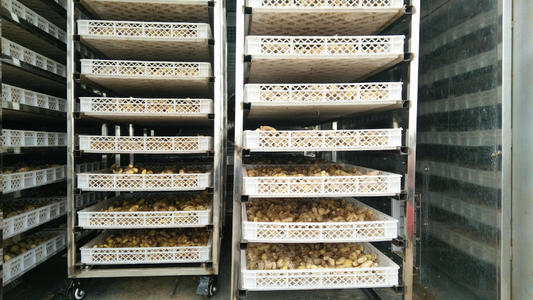
Maintenance methods for Chinese herbal slices include the lime drying method, alcohol-based insect prevention, chemical insect control (such as sulfur fumigation), controlled atmosphere storage, antagonistic storage, and refrigeration. Warehouses for Chinese herbal slices should generally be dry and well-ventilated, protected from direct sunlight, with an indoor temperature not exceeding 20°C, a relative humidity between 35% and 75%, and the moisture content of the slices kept below 13% (except for special varieties).

-
For medicinal materials rich in starch, such as Rhizoma Alismatis, Rhizoma Dioscoreae, Radix Puerariae, and Radix Astragali, the sliced pieces should be dried promptly after cutting. They should be stored in a well-ventilated, dry, and cool place to prevent insect infestation and moisture absorption.
-
For medicinal materials rich in volatile oils, such as Herba Menthae, Radix Angelicae Sinensis, Radix Aucklandiae, and Rhizoma Chuanxiong, the drying temperature should be kept below 30°C after slicing, as temperatures above 30°C may cause loss of active ingredients. During storage, the ambient temperature should not be too high; otherwise, the aroma may dissipate or the pieces may become oily. Excessively high temperatures may also lead to moisture absorption, mold growth, and insect infestation. They should be stored in a cool and dry place.
-
For sliced pieces containing high levels of sugar and mucilage, such as Herba Cistanches, Radix Rehmanniae Preparata, Radix Asparagi, and Radix Codonopsis, drying is difficult after processing. In environments with high temperature and humidity, they easily become soft and sticky, and are prone to contamination. Measures should be taken to prevent mold and insect infestation, and they should be stored in a well-ventilated and dry place.
-
For seed-type medicinal materials that have been stir-fried, such as Fructus Perillae, Semen Platycladi, Semen Raphani, and Semen Coicis, the aroma is enhanced after processing. They should be stored in sealed jars or containers to prevent insect infestation and rodent damage.
-
For sliced pieces processed with wine, such as Radix Angelicae Sinensis, Radix Dichroae, and Radix et Rhizoma Rhei, and those processed with vinegar, such as Flos Genkwa, Radix Kansui, Rhizoma Cyperi, and Radix Kansui, all should be stored in airtight containers and kept in a cool place.
-
For sliced pieces processed with salt, such as Rhizoma Alismatis, Rhizoma Anemarrhenae, Semen Plantaginis, and Radix Morindae Officinalis, they easily absorb moisture from the air and may become soft due to dampness. If the temperature is too high, moisture loss may cause salt to crystallize on the surface. Therefore, they should be stored in airtight containers and kept in a well-ventilated and dry place to prevent moisture absorption.
-
For sliced pieces processed with honey, such as Flos Farfarae, Radix Glycyrrhizae, and Folium Eriobotryae, the sugar content is relatively high after processing, making them difficult to dry. They are particularly prone to becoming soft, sticky, or clumped due to moisture absorption, and are easily contaminated, infested by insects, affected by mold, or damaged by rodents. They should be stored in jars or containers, kept as airtight as possible to avoid moisture absorption, and maintained in a well-ventilated and dry place.
-
For certain mineral-type sliced pieces, such as Borax and Natrii Sulfas, they tend to lose their water of crystallization and effloresce in dry air. Therefore, they should be stored in sealed jars or containers and kept in a cool place.
The above is Anhui Boyao Qiancao National Medicines Co., Ltd.'s detailed explanation on "How to Store and Maintain Chinese Herbal Slices." If you are looking for Anhui Boyao Qiancao National Medicines Co., Ltd., please feel free to contact us!
 English


